
I have developed a fascination with ancient looms. It fascinates me that you can literally take a bunch of sticks and cording and assemble a loom from it. The Greek-style warp-weighted loom that is my first ancient loom project is also very portable. You just untie the pieces of the frame, move the pieces, and tie them back together again. Cool!
I made trim/strapping to test out my loom. It worked! My weaving skills still need a bit of work, so I’m sticking with simple plain weave for now. I figure that once I log a bunch of hours doing the simplest weaving technique, then I’ll more likely be successful with more complex patterns. I also wanted to try weaving something larger than the 1-inch wide pieces I’ve been making. I decided to attempt weaving a 30×31 inch saddle blanket.
So … I bought an 8 foot pole that’s supposed to be the rail you hang things on in a closet. I cut it in half. Those are my new support beams for the loom. The original support beams are also closet poles, but they’re about 2.5 feet long.
A few days ago, I started warping it. I’m still not finished! It takes A LOT of aran-weight cotton yarn to reach 31 inches wide. (I know that the ancient Greeks were not weaving with cotton, but my horse really hates being zapped by static electricity, so I did not want to use wool.)
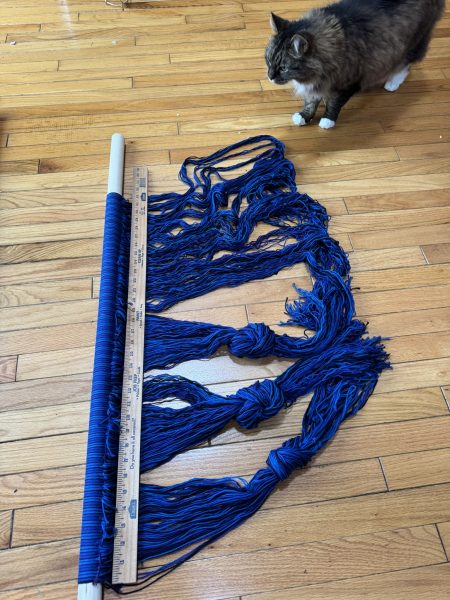
To my knowledge, we don’t know exactly how ancient Greek looms were warped. (If there is evidence of how exactly ancient Greeks warped their looms, please tell me! stella@stelladalodi.org) I stared at many pictures of looms on Greek pottery. I’ve been tying the warp threads to the top beam, leaving the end of the thread dangling, then typing a weight to the dangling end. I’m really good at tying simple knots now. I quickly started to wonder about faster ways to warp a warp-weighted loom. I have some ideas that I’ll try on future projects.
I flipped the top beam over and split the warp into sheds.
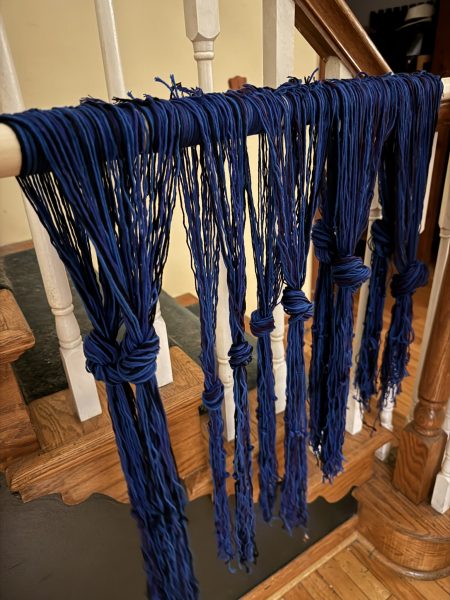
I tied the top and bottom beams onto the vertical loom supports and started tying weights.
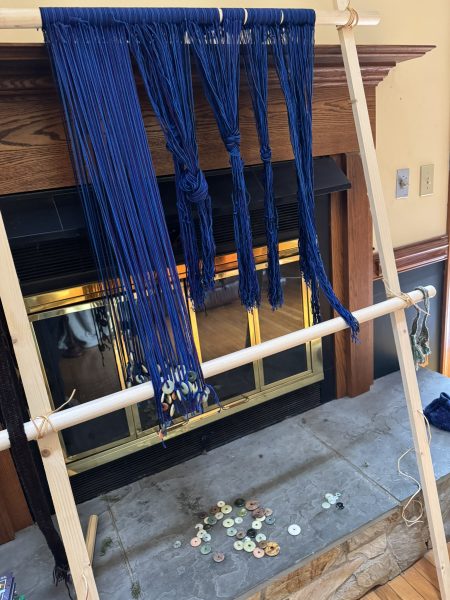
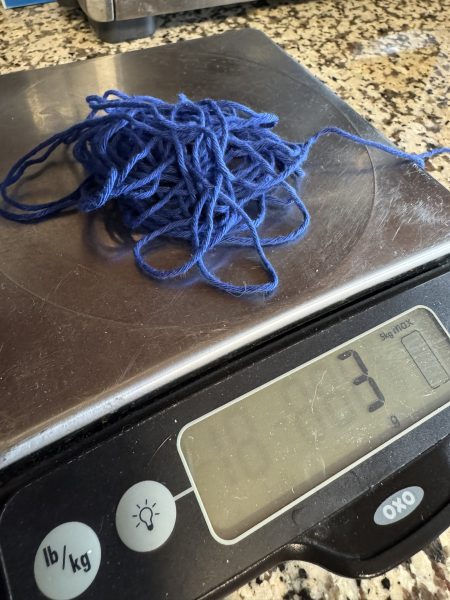
On a warp-weighted loom it’s gravity that provides the tension. The ancient Greeks used warp weights made from clay or stone. The weights need to at least weigh more than the warp threads. Each warp string weighs about 3 grams. I have a bunch of stone rings that weigh at least 3g.
But I ran out of stone weights.
I promptly ordered more stone weights. But I have no patience at all and wracked my brain for something else I could use as weights in the meantime. I described the loom to my dad during a recent visit, and he said “couldn’t you just use hardware nuts that go with bolts?” I replied “Hmm. I don’t think the Greeks used metal loom weights.” Well now I’m desperate. So off to Lowe’s I went and bought 40 nuts.
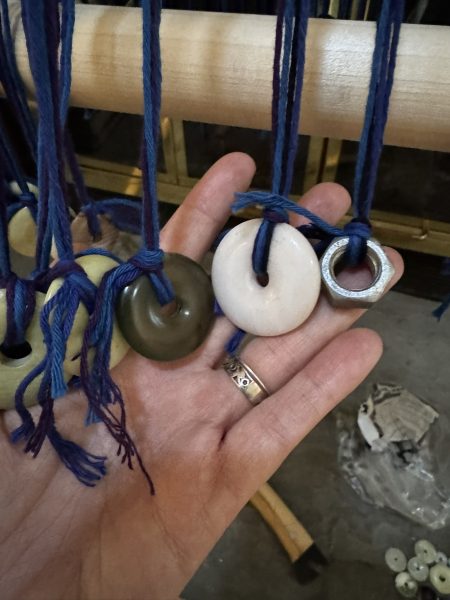
I ran out of metal weights. Sigh.
I’m going to re-tie the weights so that each weight is holding more warp threads. First I’ll re-weigh everything to make sure that gravity continues to work in my favor.
Then I can actually get to weaving! After I figure out a way to set up the heddle bar that isn’t as troublesome as the previous one. I think the heddle strings should be shorter than the ones I used previously. On those projects they kept sliding all over the place and getting tangled.